HashMap vs. TreeMap vs. Hashtable vs. LinkedHashMap
原文地址:http://www.programcreek.com/2013/03/hashmap-vs-treemap-vs-hashtable-vs-linkedhashmap/
Map 是 Java 中最重要的数据结构之一。 在这篇文章中,我将演示如何使用不同类型的 Map,如 HashMap,TreeMap,HashTable 和 LinkedHashMap。
1. Map 概述
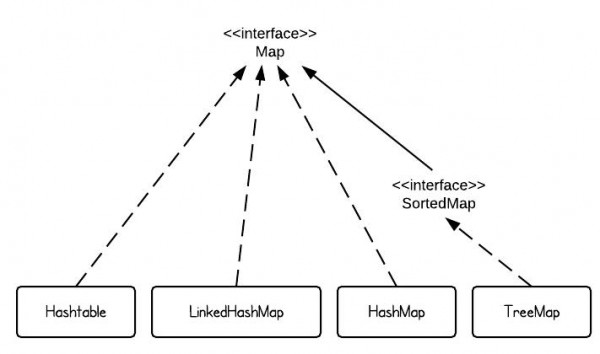
Java SE 中有 4 个常用的 Map 实现-- HashMap,TreeMap,Hashtable 和 LinkedHashMap。 如果我们用一句话描述它们:
- HashMap 被实现为哈希表,并且在键或值上没有进行排序。
- TreeMap 基于红黑树结构实现,按键排序。
- LinkedHashMap 保留插入的顺序
- Hashtable 与 HashMap 相比,它是同步的,它具有同步的开销。
因为如果程序是线程安全的,应该使用 HashMap。
2. HashMap
如果 HashMap 的键是自定义对象,则需要遵循 equals() 和 hashCode() 约定。
class Dog {
    String color;

    Dog(String c) {
        color = c;
    }
    public String toString(){
        return color + " dog";
    }
}

public class TestHashMap {
    public static void main(String[] args) {
        HashMap<Dog, Integer> hashMap = new HashMap<Dog, Integer>();
        Dog d1 = new Dog("red");
        Dog d2 = new Dog("black");
        Dog d3 = new Dog("white");
        Dog d4 = new Dog("white");

        hashMap.put(d1, 10);
        hashMap.put(d2, 15);
        hashMap.put(d3, 5);
        hashMap.put(d4, 20);

        //print size
        System.out.println(hashMap.size());

        //loop HashMap
        for (Entry<Dog, Integer> entry : hashMap.entrySet()) {
            System.out.println(entry.getKey().toString() + " - " + entry.getValue());
        }
    }
}
输出结果为:
4
white dog - 5
black dog - 15
red dog - 10
white dog - 20
注意这里,我们错误地添加了两次 "white dog",但是 HashMap 接受了它。 这是没有道理的,因此现在我们很困惑,到底有多少只"white dog" 在里面。
Dog 类应该定义成下面这样:
class Dog {
    String color;

    Dog(String c) {
        color = c;
    }

    public boolean equals(Object o) {
        return ((Dog) o).color.equals(this.color);
    }

    public int hashCode() {
        return color.length();
    }

    public String toString(){
        return color + " dog";
    }
}
现在结果为:
3
red dog - 10
white dog - 20
black dog - 15
原因是 HashMap 不允许两个相同的元素。 默认情况下,如果要使用 Object 类,必须要实现 hashCode() 和 equals() 方法。 对于不同的对象,默认的 hashCode() 方法返回不同的整数,当引用相同的对象时,equals() 方法只返回 true。 如果不太清楚,请查看 the hashCode() and equals() contract 。
点击 most frequently used methods for HashMap 查看 HashMap 常用的方法,如迭代,打印等。
3. TreeMap
TreeMap 按键排序,我们先来看看下面的例子,了解一下“按键排序”的思想。
class Dog {
    String color;

    Dog(String c) {
        color = c;
    }
    public boolean equals(Object o) {
        return ((Dog) o).color.equals(this.color);
    }

    public int hashCode() {
        return color.length();
    }
    public String toString(){
        return color + " dog";
    }
}

public class TestTreeMap {
    public static void main(String[] args) {
        Dog d1 = new Dog("red");
        Dog d2 = new Dog("black");
        Dog d3 = new Dog("white");
        Dog d4 = new Dog("white");

        TreeMap<Dog, Integer> treeMap = new TreeMap<Dog, Integer>();
        treeMap.put(d1, 10);
        treeMap.put(d2, 15);
        treeMap.put(d3, 5);
        treeMap.put(d4, 20);

        for (Entry<Dog, Integer> entry : treeMap.entrySet()) {
            System.out.println(entry.getKey() + " - " + entry.getValue());
        }
    }
}
输出结果:
Exception in thread "main" java.lang.ClassCastException: collection.Dog cannot be cast to java.lang.Comparable
    at java.util.TreeMap.put(Unknown Source)
    at collection.TestHashMap.main(TestHashMap.java:35)
由于 TreeMaps 是按键排序的,所以键的对象必须能够相互比较,这就是为什么它必须实现 Comparable 接口。 例如,你可以使用 String 作为键,因为 String 实现了 Comparable 接口。
让我们修改下 Dog 类,使之变得可比:
class Dog implements Comparable<Dog>{
    String color;
    int size;

    Dog(String c, int s) {
        color = c;
        size = s;
    }

    public String toString(){
        return color + " dog";
    }

    @Override
    public int compareTo(Dog o) {
        return  o.size - this.size;
    }
}

public class TestTreeMap {
    public static void main(String[] args) {
        Dog d1 = new Dog("red", 30);
        Dog d2 = new Dog("black", 20);
        Dog d3 = new Dog("white", 10);
        Dog d4 = new Dog("white", 10);

        TreeMap<Dog, Integer> treeMap = new TreeMap<Dog, Integer>();
        treeMap.put(d1, 10);
        treeMap.put(d2, 15);
        treeMap.put(d3, 5);
        treeMap.put(d4, 20);

        for (Entry<Dog, Integer> entry : treeMap.entrySet()) {
            System.out.println(entry.getKey() + " - " + entry.getValue());
        }
    }
}
结果为:
red dog - 10
black dog - 15
white dog - 20
结果是按键排序的,例子中为 "dog size"。
如果将例子中的 "Dog d4 = new Dog("white", 10);" 替换为 "Dog d4 = new Dog("white", 40);", 结果将是:
white dog - 20
red dog - 10
black dog - 15
white dog - 5
原因是 TreeMap 使用compareTo()方法比较键。不同的 size 代表不同的 dog。
4. Hashtable
Java 文档的解释: HashMap 大致相当于 Hashtable,除了它是不同步的,并允许空值,而 Hashtable 则不行。
5. LinkedHashMap
LinkedHashMap 是 HashMap 的子类。 这意味着它继承了 HashMap 的全部功能。 另外,链表还保留了插入顺序。
我们用与 HashMap 相同的代码来测试(LinkedHashMap 替换 HashMap):
class Dog {
    String color;

    Dog(String c) {
        color = c;
    }

    public boolean equals(Object o) {
        return ((Dog) o).color.equals(this.color);
    }

    public int hashCode() {
        return color.length();
    }

    public String toString(){
        return color + " dog";
    }
}

public class TestHashMap {
    public static void main(String[] args) {

        Dog d1 = new Dog("red");
        Dog d2 = new Dog("black");
        Dog d3 = new Dog("white");
        Dog d4 = new Dog("white");

        LinkedHashMap<Dog, Integer> linkedHashMap = new LinkedHashMap<Dog, Integer>();
        linkedHashMap.put(d1, 10);
        linkedHashMap.put(d2, 15);
        linkedHashMap.put(d3, 5);
        linkedHashMap.put(d4, 20);

        for (Entry<Dog, Integer> entry : linkedHashMap.entrySet()) {
            System.out.println(entry.getKey() + " - " + entry.getValue());
        }
    }
}
输出结果为:
red dog - 10
black dog - 15
white dog - 20
不同的是,如果我们使用 HashMap,输出可能是以下 - 插入顺序不被保留:
red dog - 10
white dog - 20
black dog - 15